


 Share
Share
 Tweet
Tweet
 Pin
Pin
 Email
Email
 Share
Share
 Share
Share
 Share
Share
Maldives .....the sunny side of life!!
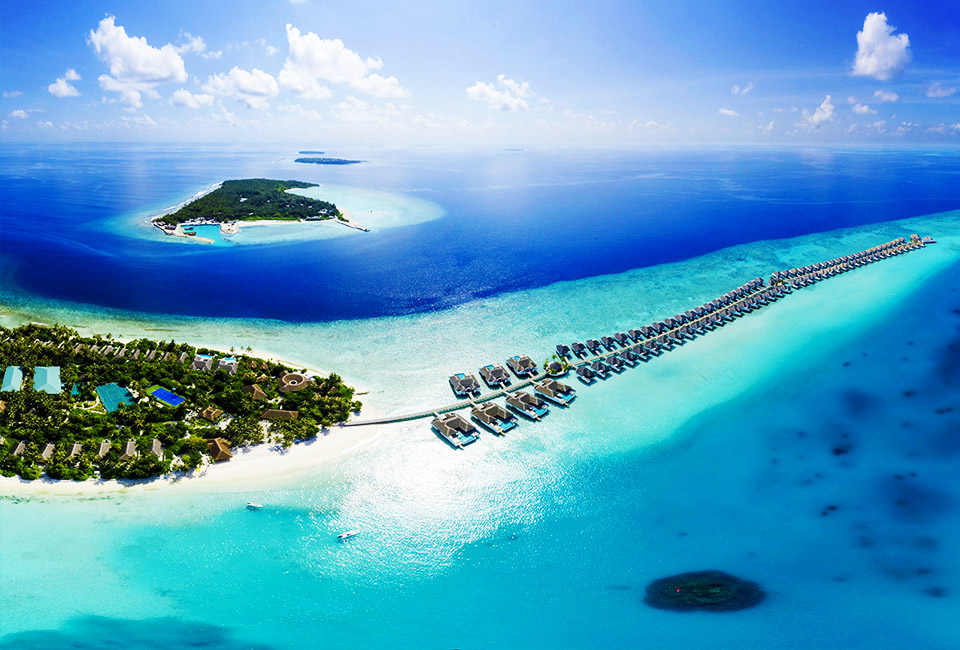
The Maldives is an archipelago of 1,192 coral islands grouped into 26 natural coral atolls in the Indian Ocean. Coral islands measure not more than 1.8 meters above sea level. The Maldives are one of the most geographically dispersed as well as the smallest country in Asia. With Over a 436,330 population of this small country only 200 islands are inhabited. The Maldives, located on top of a vast underwater mountain range have around 1190 islands and sandbanks. The pearl string like islands covers a land area of no less than 298 km2. All the islands are encircled by a lagoon blessed with crystal clear water.
The Maldives is known to locals in their native language (Dhivehi) as Dhivehi Raajje. With its white sand beaches and turquoise crystal blue sea and the scenic coconut palms surrounding everywhere, the Maldives are portrayed by travel companies as a tropical paradise.
These islands are protected by a reef structure, housing one of the most exclusive and spectacular underwater life.
The Maldives is an old nation, well over 2,500 years old according to legends of the southern atolls. The ancient history of Maldives is told in copperplates, ancients scripts carved on coral artifacts, traditions, language and different ethnicities of Maldivians. The first Maldivians did not leave any archaeological artifacts. Their buildings were probably built of wood, palm fronds, and other perishable materials, which would have quickly decayed in the salt and wind of the tropical climate. Moreover, chiefs or headmen did not reside in elaborate stone palaces, nor did their religion require the construction of large temples or compounds.
For many centuries the Maldivian economy was entirely dependent on fishing and other marine products. Fishing remains the main occupation of the people and the government gives priority to the fisheries sector. As of 2010, fisheries contributed over 15% of the country's GDP and engaged about 30% of the country's workforce. Fisheries were also the second-largest foreign exchange earner after tourism.
After the long Buddhist period of Maldivian history, Muslim traders introduced Islam. Maldivians converted to Islam by the mid-12th century. The islands have had a long history of Sufic orders, as can be seen in the history of the country such as the building of tombs. They were used until as recently as the 1980s for seeking the help of buried saints. They can be seen next to some old mosques and are considered a part of Maldives's cultural heritage.
Since the 12th century AD, there were also influences from Arabia in the language and culture of the Maldives because of the conversion to Islam and its location as a crossroads in the central Indian Ocean. This was due to the long trading history between the far east and the middle east. Reflective of this is the fact that the Maldives has had the highest national divorce rate in the world for many decades. This, it is hypothesized, is due to a combination of liberal Islamic rules about divorce and the relatively loose marital bonds that have been identified as common in non- and semi-sedentary peoples without a history of fully developed agrarian property and kinship relations
Velana International Airport is the principal gateway to the Maldives; it is near the capital city Malé and is surrounded by water. International travel is available on government-owned Island Aviation Services (branded as Maldivian), which operates to nearly all Maldives domestic airports with several Bombardier Dash 8 aircraft, and one A320 with international service to India, Bangladesh, China, and Thailand.
In Maldives, there are three main ways to travel between islands: by domestic flight, by seaplane, or by boat. For several years there were two seaplane companies operating: TMA (Trans Maldivian Airways) and Maldivian Air Taxi, but these merged in 2013 under the name TMA. The seaplane fleet is entirely made up of DHC-6 Twin Otters. There is also another airline, Flyme, which operates using ATR planes to domestic airports, principally Maamigili, Dharavandhoo and some others.
To create, discover, preserve and disseminate knowledge that is necessary to enhance the lives and livelihoods of people and essential for the cultural, social and economic development of the society so that this nation shall remain free and Islamic forever. On 17 January 2011 the Maldives National University Act was passed by the President of the Maldives.
The Maldives have a range of different habitats including deep sea, shallow coast, and reef ecosystems, fringing mangroves, wetlands and dry land. There are 187 species of coral forming the coral reefs. This area of the Indian Ocean, alone, houses 1,100 species of fish, 5 species of sea turtle, 21 species of whale and dolphin, 400 species of mollusk, and 83 species of echinoderms. The area is also populated by a number of crustacean species: 120 copepods, 15 amphipods, as well as more than 145 crab and 48 shrimp species.Maldives