


 Share
Share
 Tweet
Tweet
 Pin
Pin
 Email
Email
 Share
Share
 Share
Share
 Share
Share
Pashupatinath Temple
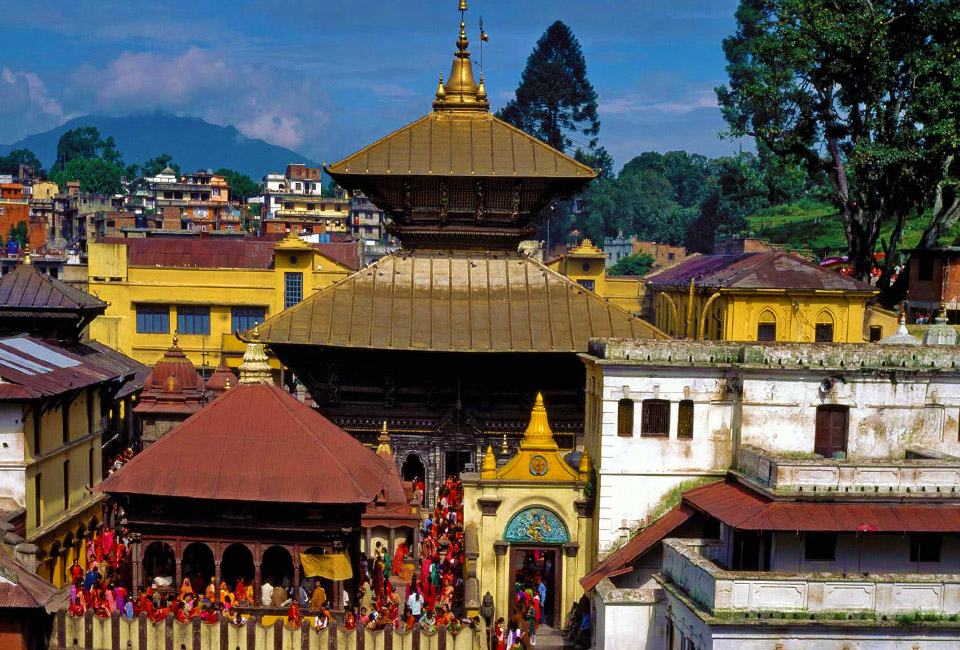
Pashupatinath Temple is one of the most significant Hindu site not just in Nepal but in all of Asia for the devotees of Lord Shiva. Built in the 5th century and later renovated by Malla kings, the site itself is said to have existed from the beginning of the millennium when a Shiva lingam was discovered here. The temple is located on the banks of the Bagmati River, approximately 5 km north-east of Kathmandu in the eastern part of Kathmandu Valley. The pashupatinath temple spreads across 246 hectors of land abounds in temples and monuments and was enlisted as a UNESCO world heritage site in 1979.
There are many legends that narrate as to how the temple came in to existence. All intriguinging in their own sense. Here are a few popular ones:
- The Legend of the cow:
When lord Shiva came down to earth in the form of an antelope in the forest on the banks of Bagmati, other gods caught up to him holding him by one of his horns which led to him resuming his divine form. The broken horn was worshipped as a Shivalinga but as time passed by it got buried in the earth. Then centuries later a herdsman noticed one of his cows showering all of her milk on a specific place. Upon digging the site the divine linga of pashupatinath was discovered.
- Licchavi Legend
According to Gopalraj Aalok Vamsavali, the temple was established by Prachanda Deva, a Licchavi King who, according to a stone inscription put in Pashupatinath's courtyard by Jayadeva 11 in 753 AD, ruled 39 generations before Manadeva (464-505 AD).
- The Devalaya Legend
Another chronicle states that Pashupatinath Temple was in the form of Linga shaped Devalaya before Supuspa Deva constructed a five-storey temple of Pashupatinath in this place. As the time passed, the need for repairing and renovating this temple arose. It is learnt that this temple was reconstructed by a medieval King named Shivadeva (1099-1126 AD). It was renovated by Ananta Malla adding a roof to it. Thousands of pilgrims from all over the world come to pay homage to this temple that is also known as 'The Temple of Living Beings'.
Apart from its Sacred significance and the enticing mythology, the site is also important for historians alike. It displays a variety of temple design some of which are Dome style, Pagoda style, Shikhara style and so on. Only Hindus are allowed through the gates of the main temple. The inner sanctum has a Shiva lingam and facing the temple sits the largest statue of Nandi the bull, the vehicle of Shiva. There are hundreds of Shiva lingamswithin the compound. Additionally there are varieties of statues and sculptures around the complex that are dedicated to many other Hindu and Buddhist deities.
The pashupati area is popular among the travelers as they get a chance to witness the open air cremation. The cremation of Hindus take place on raised pyres along the bagmati river banks. Also for Sadhus. The ascetic yogis meditate and worship around the temple area for their liberation from the cycle of birth and death.
Daily Rituals at Pashupatinath Temple
Pashupatinath is also one of the few living cultural heritage sites in the world. Unlike other cultural sites or museums, Pashupatinath is the centre of energy with active participation of people at all times of the day, every day. The daily rituals of Pashupatinath Temple are as follows:
4:00 am: West gate opens for visitors.
8:30 am: After arrival of Pujaris, the idols of the Lord are bathed and cleaned, clothes and jewelry are changed for the day.
9:30 am: Baal Bhog or breakfast is offered to the Lord.
10:00 am: Then people who want to do Puja are welcomed to do so. It is also called Farmayishi Puja, whereby people tell the Pujari to carry out a special Puja for specific reasons. The Puja continues till 1:45 pm in the afternoon.
1:50 pm: Lunch is offered to the Lord in the main Pashupati Temple.
2:00 pm: Morning prayers end.
5:15 pm: The evening Aarati at the main Pashupati Temple begins.
6:00 pm onward: In recent times the Bagmati Ganga Aarati that is done by the banks of the Bagmati has been gaining popularity. There are larger crowds attending on Saturdays, Mondays and on special occasions. Ganga Aarati along with Shiva’s Tandava Bhajan, written by Ravana, is carried out during the evening Ganga Aarati.
7:00 pm: Doors close.