


 Share
Share
 Tweet
Tweet
 Pin
Pin
 Email
Email
 Share
Share
 Share
Share
 Share
Share
Bhutan: The land of Thunder Dragon
Bhutan, Buddhist kingdom on the Himalayas’ eastern edge is known for it’s great beauty and mystery. Bhutan is known to the world today as The Last Shangrila. Country also known as Druk Yul or Land of the Thunder Dragon is rooted in tradition, this tiny kingdom was largely isolated from the rest of the world for centuries. Landlocked Himalayan kingdom situated between India and China developed to be rich in religious, cultural and artistic heritage. The profound teachings of Buddhism remains well preserved and exerts a strong influence in all aspects of life. It enjoys the reputation for authenticity, religious and a well-protected cultural heritage and natural environment. Due to its pristine environment and harmonious society the fortunate visitors will find a rare combination of warm hospitality and (with) incredible nature beauty.
It is a land of unspoiled alpine valleys and beautiful mountain peaks dotted with Dzongs(fortresses). The entire country is mountainous except for a small strip of subtropical plains in extreme south. The elevation rises from 200m(660ft) in the southern foothills to more than 7,000m(23,000ft) above sea level and makes the country an ecological ‘hotspot’.
Being one of the isolated nation in the world, tourism started in 1974 and is regulated by the government emphasizing on the preservation of its culture and environment. The Royal Government of Bhutan recognizes that tourism is an important means for achieving socioeconomic development and also an opportunity in promoting and understanding among peoples and building closer ties of friendship based on appreciation and respect for different cultures and lifestyles. The Royal Government has adopted a very cautious approach to growth and development of the tourism sector. This industry is based on principle of sustainability that is ‘tourism must be environmentally and ecologically friendly, socially and culturally acceptable and economically viable’. The traditional economy of the country was based on forestry, animal husbandry and subsistence agriculture. Though the increase in export of hydroelectricity and inflow in tourism sector, these has played a major role to contribute in the national economy.
Thimphu is the capital and largest city. The only airport of the country is in Paro Valley which is one hour drive from the capital.
‘Dzongkha’ is Bhutan’s national language. English is commonly spoken in all major cities. Both the language are the medium of education in schools throughout the country.
National Flag
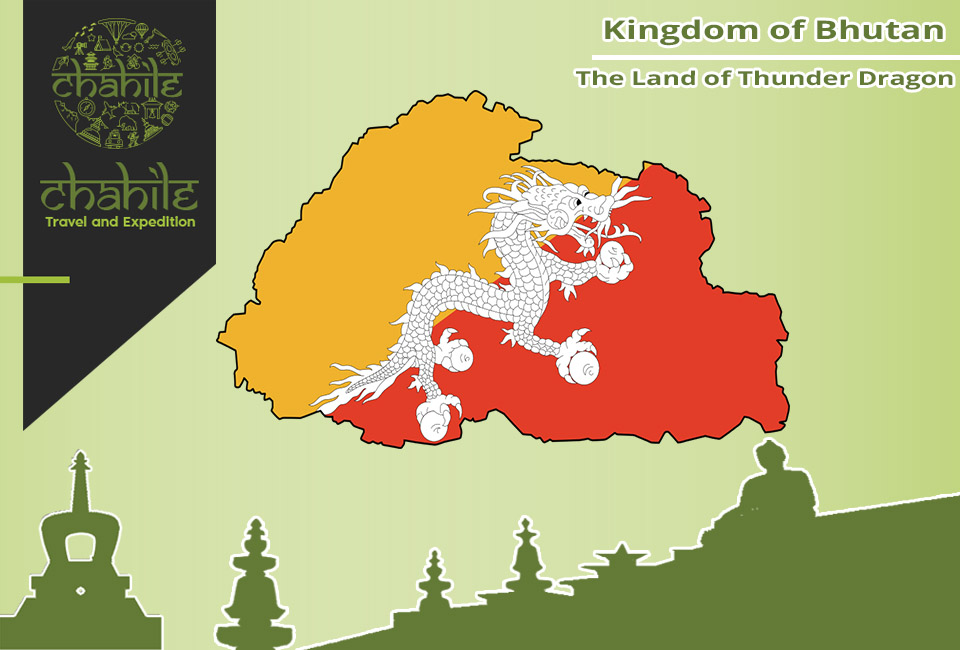
The National flag is divided diagonally into two equal halves with yellow and saffron-orange. As restated in the Constitution of 2008, the yellow signifies civil tradition and temporal authority as embodied in the Druk Gyalpo, the Dragon king of Bhutan whose royal garb traditionally includes a yellow kabney(scarf). The saffron-orange half signifies Buddhist spiritual tradition, particularly the Drukpa Kagyu and Nyingma schools. The Thunder dragon spreads equally over the line between the colors. The placement of Druk in the center of the flag over the dividing line between the flag’s two colors signifies the equal importance of both civic and monastic traditions in the Kingdom of Druk(Bhutan) and evokes the strength of the sacred bond between sovereign and people. The white color of Druk signifies the purity of inner thoughts and deeds that unite all the ethnically and linguistically diverse people of Bhutan. The jewels held in Druk’s claws represents Bhutan’s wealth and the security and protection of its people while the dragons snarling mouth symbolizes Bhutanese deities’ commitment to the defense of Bhutan.
National Emblem
The National Emblem of Bhutan maintains several elements, contained in a circle is composed of a double diamond thunderbolt (dorje) place above a lotus surmounted by a jewel and framed by two dragons. The thunderbolt represents the harmony between secular and religious power. The lotus symbolizes purity. The jewel express sovereign power and the two dragons (male and female) stands for the name of the country which they proclaim with their great voice, the Thunder.
National Bird
The National Bird is the Raven. It adorns the royal crown. The raven represents the deity Gnopo Jarodongchen (raven headed Mahakala), one of the chief guardian deities of Bhutan.
National Animal
The national animal is the Takin(Burdorcastaxicolor) that is associated with religious history and mythology. It is a very rare mamma with thick neck and short muscular legs. It lives in groups and is found and is found above 4000 meters on the north-western and far north eastern parts of the country. It lives on bamboo and an adult Takin can weigh over 200 kgs.
National Flower
The national flower of Bhutan is the Himalayan Blue Poppy (Meconopsis Grandis). It is a delicate blue or purple tinged blossom with a white filament. It grows to a height of 1 meter on the rocky mountain terrain, above the tree line at altitudes of 3500m to 4500m.
National Tree
The Himalayan cypress (Cypressus torolusa) is the national tree of Bhutan. They are associated with religion and one may often notice large cypresses near religious structures and in the temperate zone between altitudes of 1800m and 3500m. Its capacity to survive on rugged harsh terrain is compared to bravery and simplicity.